Overhead · Guide
Overhead service: drop, mast and weatherhead
An overhead service brings the utility's service drop from a pole-mounted transformer to a weatherhead on the building. Service-entrance conductors run from the weatherhead down a mast or conduit to the meter base. The drop must clear grade by at least 10 feet, residential driveways by 12 feet and streets by 18 feet, and the weatherhead must sit above the point where the drop attaches.
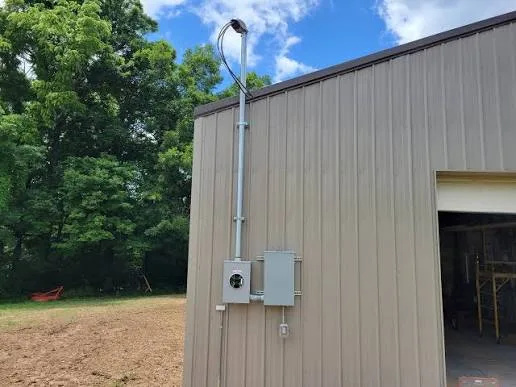
What are the parts of an overhead service?
- Service drop: the utility's triplex cable from the pole to the building.
- Point of attachment: a service insulator or mast clamp that carries the drop's weight.
- Weatherhead: the rain-tight cap where service-entrance conductors exit, with drip loops below it.
- Mast or conduit: rigid metal conduit or IMC through the roof or up the wall, strapped every few feet.
- Meter base and disconnect: the meter socket and, under the 2026 NEC, an outdoor service disconnect.
What clearances does the service drop need?
| Location (120/240 V) | Minimum clearance |
|---|---|
| Finished grade, sidewalks, pedestrian-only areas | 10 ft |
| Residential property and driveways | 12 ft |
| Public streets, alleys and roads | 18 ft |
| Above a roof (general) | 8 ft |
From NEC 230.24. Your utility may require more, and some utilities set a minimum height for the point of attachment.
How do you install the weatherhead and drip loops?
Mount the weatherhead above the point of attachment (NEC 230.54) so water drains away from the conductors, and leave enough conductor out of the head to form drip loops that sit below it. Leave about 3 feet of conductor for the utility to splice to the drop.
Safety: never work near an energized service drop. The utility disconnects and reconnects the drop.
Mast kits, weatherheads and meter bases are on our service parts list. Choosing a meter base? Read the meter base guide.
Frequently asked questions
How high does an overhead service drop need to be?
NEC 230.24(B) sets minimum clearances for 120/240-volt service drops: 10 feet above finished grade and areas accessible only to pedestrians, 12 feet over residential driveways, and 18 feet over public streets and roads. Utilities may require more.
How high must a service mast extend above the roof?
Service drop conductors generally need 8 feet of clearance above a roof. A reduced clearance of 18 inches is allowed when the mast passes through the roof within 4 feet of the edge and the drop terminates at a through-the-roof mast. Utilities often limit unsupported mast height and require a guy wire above a set height.
Can I attach cable or TV lines to the service mast?
No. NEC 230.28 allows only power service-drop conductors to be attached to a service mast.
Sources: NFPA 70 (NEC) 230.24, 230.28, 230.54.