DIY · New construction
How to set up a temporary power pole
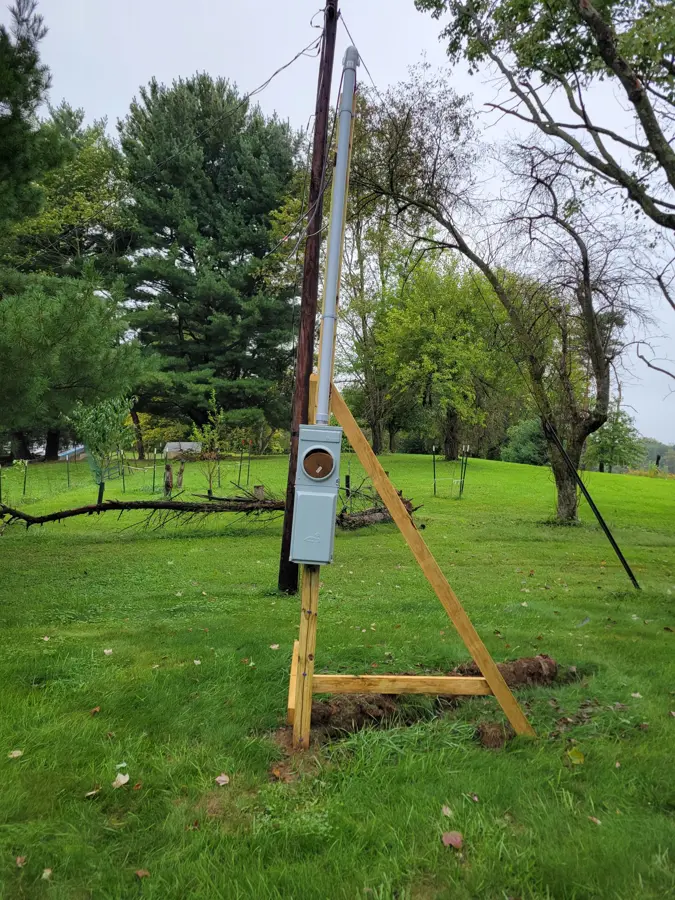
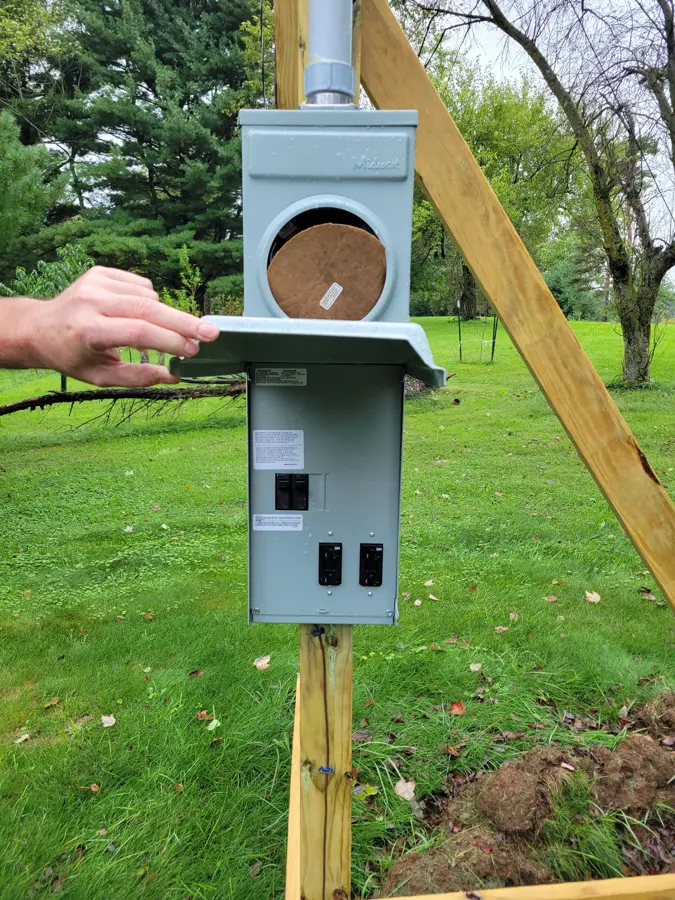
A temporary power pole is a braced, treated post set about 4 feet deep near the utility's pole or transformer, carrying a temporary power outlet panel: a meter socket, main breaker and GFCI-protected outlets. You build it, ground it with an 8 ft rod, get an electrical permit and inspection, and then the utility runs a service drop to it and sets the meter.
Disclosure: some links on this page are affiliate links. We may earn a commission at no extra cost to you. How we make money.
Before you start: a temporary pole is a real electric service. It needs a permit and an inspection, and only the utility connects it. Your utility's temporary-service sheet overrides every number on this page.
What is a temporary power pole?
It is the construction-site power supply used before the house has its permanent service. The utility feeds it with an overhead drop or an underground line, and it powers saws, compressors, lights and a well pump while the house is built. It comes down once the permanent service is live.
Do you need a permit for a temporary power pole?
Yes. The building department inspects the pole, and the utility won't connect until the inspector releases it. Apply for temporary service with the utility at the same time. AEP Ohio's temporary service request, for example, asks whether the service is overhead or underground and how far the site is from the nearest pole with a transformer (AEP Ohio).
What size post do you need, and how deep?
Utilities publish their own minimums. These are typical, and they show why you should check yours before buying lumber:
| Source | Post | Depth | Notes |
|---|---|---|---|
| AES Ohio | Two 2x6s joined, or 4x4 min., 16 ft long | — | Braces required; 3 2x4 braces staked 24 in. into the ground |
| OPPD | Treated, 16 ft min.; 6x6 allowed | 4 ft min. | At least 12 ft above ground; no more than 75 ft from the utility pole |
| Rocky Mountain Power | 6x6 timber, 20 ft min. | 60 in. | 25 ft if the drop crosses a road or traffic area |
| California Title 8 | 6x6, 20 ft min. | 4 ft | 4x4 allowed in pedestrian-only areas with 10 ft clearance |
How do you set up a temporary power pole, step by step?
- Apply with the utility. Get the pole location, maximum distance and any special parts (some utilities supply a clevis or insulator for you to install).
- Call 811 and wait for buried lines to be marked before digging.
- Pull the electrical permit.
- Mount the panel and riser on the post while it's on the ground. Set the meter socket at the height your utility requires, run the riser conduit to the top, and add the weatherhead and drop attachment.
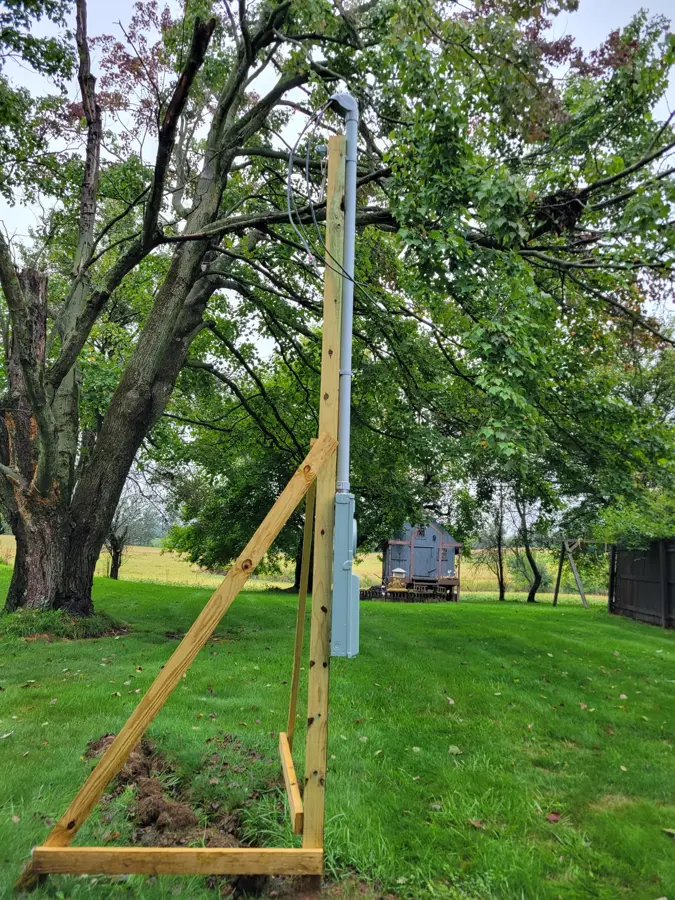
- Set and brace the post. Dig to the required depth, plumb the post, brace it in two directions, and tamp the backfill in layers.
- Drive the ground rod and run bare copper from the panel's grounding lug to an acorn clamp on the rod.
- Leave conductor tails out of the weatherhead for the utility's connection. Rocky Mountain Power, for example, asks for at least 24 inches (RMP).
- Call for inspection, then confirm the utility received the release.
- The utility connects the drop and sets the meter. Test every GFCI before using the outlets.
Do temporary power outlets need GFCI protection?
Yes. NEC 590.6(A) requires GFCI protection for 125 V and 125/250 V, 15, 20 and 30 A receptacles on temporary installations (Mike Holt, NEC 590). Buy a panel with GFCI outlets or GFCI breakers already installed, and keep the cover closed when cords aren't plugged in.
How high do the drop and drip loop need to be?
High enough to meet the clearances for what the drop crosses. One city's temporary pole sheet asks for a 4x6 post set 4 ft deep with the drip loop at least 10 ft above grade (temporary pole requirements). A drop over a driveway needs more height. See the clearance table in our overhead service guide.
What do inspectors reject on temporary poles?
- Post not braced or not plumb, or backfill not tamped.
- Missing GFCI protection, or a GFCI that doesn't trip when tested.
- Ground rod not fully driven, or a clamp not listed for direct burial.
- Open knockouts or unused breaker spaces without filler plates.
- Conduit not strapped to the post, or the meter socket outside the utility's height range.
- No address posted where the utility crew can see it.
The city checklist linked above lists several of these, including driving the ground rod to 8 ft, identifying all circuits and securing conduit to the pole.
Tools and parts for a temporary power pole
Panel
Temporary power outlet panel with meter socket
A meter socket, main breaker, branch breakers and GFCI outlets in one weatherproof enclosure, built to mount on a post.
- Rating
- 100 A is common for a house build; 200 A for big tools or a well pump
- Check
- Utility-approved meter socket; GFCI on every 120 V outlet
Grounding
Copper-bonded ground rod with acorn clamp
Drives 8 feet into the soil and connects to the panel with bare copper wire.
- Size
- 5/8 in. x 8 ft
- Clamp
- Listed for direct burial
Grounding
6 AWG bare solid copper wire
The grounding electrode conductor from the panel to the rod. Staple it down the post as in the photos.
- Length
- Post height plus about 3 ft
Cords
12/3 outdoor extension cord, 50 ft
Heavy cords keep saws and compressors from running on low voltage at the far end of the site.
- Gauge
- 12 AWG for runs over 50 ft or 15 A tools
Testing
GFCI receptacle tester
Press-tests each GFCI outlet before the inspector does.
- Use
- Test GFCIs weekly while the pole is in use
Next: once the house is framed, plan the permanent service with our 7 steps to get electric service and the service size calculator.
Frequently asked questions
Can a homeowner install their own temporary power pole?
In many areas, yes. Owners can usually build and set the pole, mount the panel and drive the ground rod, but the job needs an electrical permit and inspection before the utility will connect it. Some jurisdictions require a licensed electrician for any service equipment, so check with your building department first.
How deep should a temporary power pole be buried?
Most utilities require about 4 feet. OPPD requires a minimum of 4 feet with the pole solidly tamped, and Rocky Mountain Power requires 60 inches. Brace the pole until the backfill is firm, and follow your own utility's number.
Do temporary power outlets need GFCI protection?
Yes. NEC 590.6(A) requires GFCI protection for 125-volt and 125/250-volt, 15-, 20- and 30-amp receptacles used for construction. Most temporary power outlet panels come with GFCI receptacles or GFCI breakers built in.
How long can a temporary power pole stay up?
Only for the construction period. Many utilities limit temporary service to about a year; PG&E describes it as service estimated at 1 year or less, and Snohomish PUD limits it to 18 months. Plan to move power to the permanent service as soon as it passes inspection.
How close to the utility pole should a temporary pole be?
Utilities set a maximum span for the service drop. OPPD asks for the meter pole to be no more than 75 feet from its pole, and PG&E limits the drop to a temporary pole to 100 feet. Some also require a minimum gap from their pole, so get the location approved before you dig.
Sources: NFPA 70 (NEC) 590.6; AEP Ohio temporary service; AES Ohio Electric Service Handbook; OPPD Meter Manual ch. 5; Rocky Mountain Power ESR ch. 6; Cal. Code Regs. Title 8 §2405.3; PG&E customer-owned poles; Snohomish PUD.